 MILESTONES
Freelancers and contractors
A client and contractor agree on scope, deliverables, payment, and milestones. TrustLayer records the agreement and coordinates supported escrow and release actions.
Transaction integrity infrastructure
Agree on the terms. Commit the assets. Complete the transaction. Record the outcome.
TrustLayer is a transaction platform for structured agreements, non-custodial escrow, and atomic asset exchange. It gives participants one shared deal record for agreed terms, asset commitments, delivery conditions, and defined settlement outcomes.
Whether one party is funding an escrow or two parties are exchanging assets, TrustLayer coordinates the transaction from agreement to settlement.
Make every transaction verifiable.
Settlement model 01
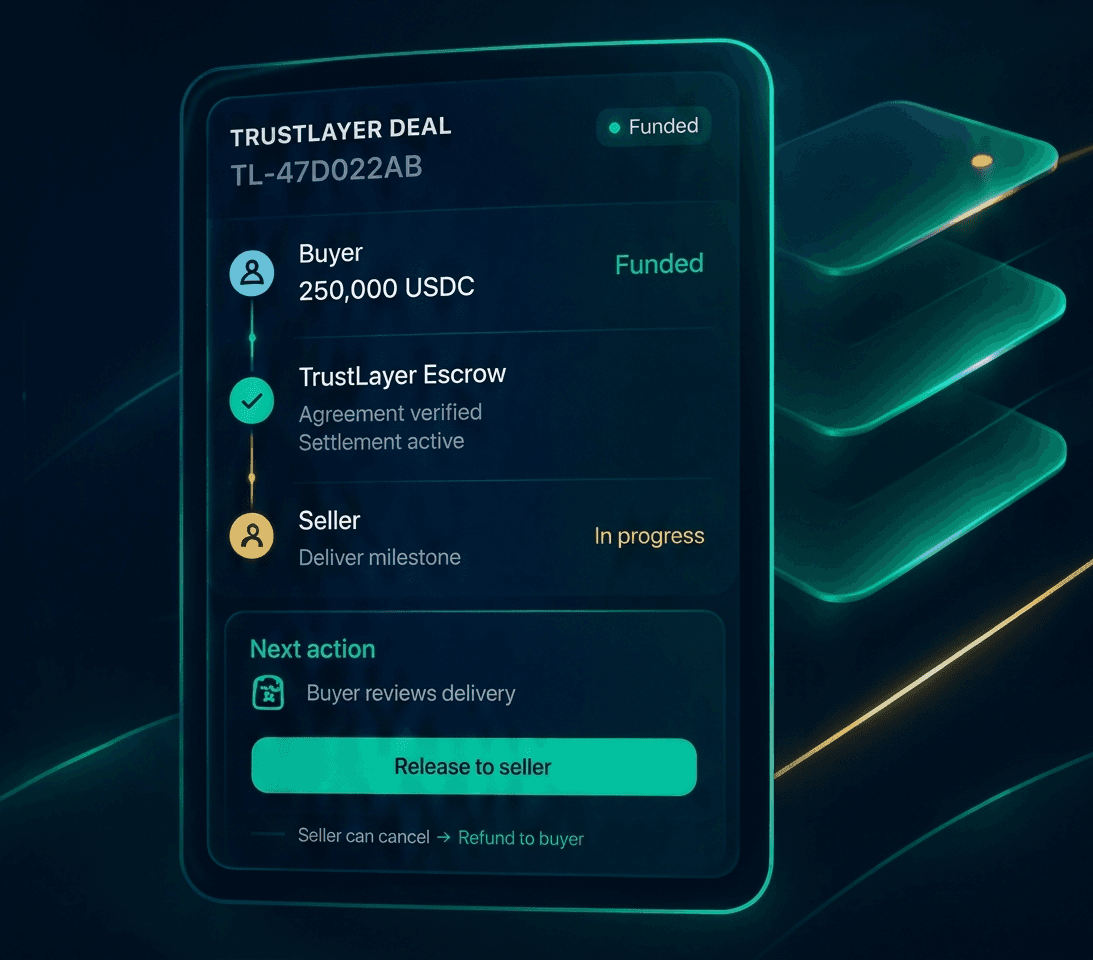
One-way escrow
Settlement model 02
Atomic exchange
Party A
Commits asset A
Party B
Commits asset B
ATOMIC SETTLEMENT
Both assets exchange under the deal rules
Two ways to settle a deal
Not every transaction works the same way. Some require one party to commit funds while another delivers. Others require two parties to commit assets for an exchange. TrustLayer supports both models through one shared transaction engine.
One party commits the agreed asset. The other party performs against the agreement before settlement follows the deal's rules.
Agree
Both parties agree on the terms, amount, delivery conditions, and milestones.
Buyer commits
The buyer authorizes funding into the non-custodial escrow program.
Seller delivers
The seller performs against the shared agreement and submits delivery evidence where required.
Settle
Release, cancellation, or dispute resolution follows the applicable deal rules.
DEFINED OUTCOMES
Two parties commit different assets to an exchange governed by their shared deal. Neither side is simply waiting for the other to release a buyer-funded payment.
Agree on the exchange
Both participants agree on the assets, quantities, conditions, and expiry.
Party A funds
The first participant authorizes funding of their exchange leg.
Party B funds
The second participant authorizes funding of their own exchange leg.
Atomic settlement
Once both legs are funded, the authorized settlement exchanges both sides according to the deal rules.
EXCHANGE OUTCOMES
Each settlement model has its own lifecycle and authorization rules. One-way escrow dispute resolution and atomic exchange cancellation or reclaim are distinct processes.
The TrustLayer transaction model
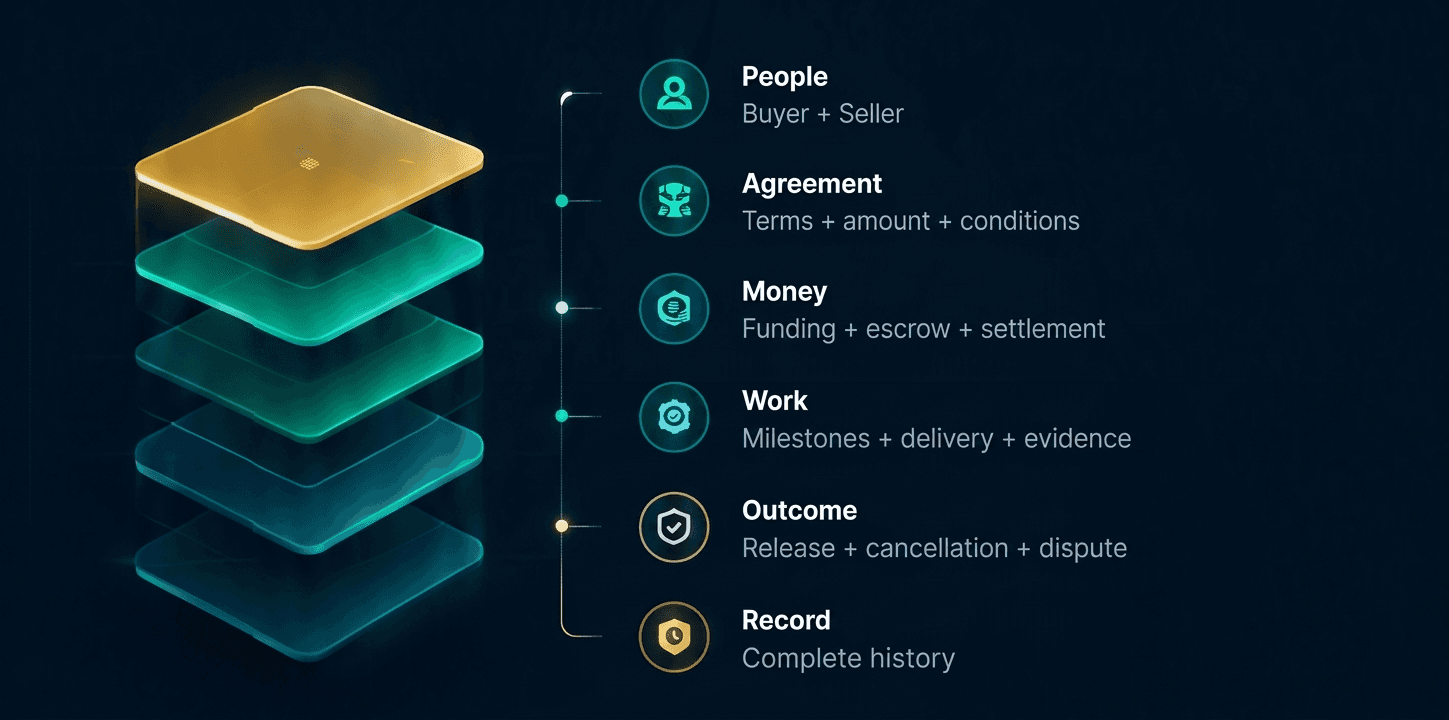
The foundation stays the same, even when the settlement method changes. Every deal connects the participants, agreement, committed assets, milestones, evidence, settlement, and final outcome.
THE COMMON FOUNDATION
PARTICIPANTS
Who is involved
The parties and their roles in the deal.
AGREEMENT
What was agreed
Terms, conditions, quantities, and obligations.
ASSETS
What is committed
The assets and amounts assigned to the deal.
MILESTONES
What must happen
Delivery stages, requirements, and evidence.
PATH A
Release, cancellation, and applicable dispute-resolution paths follow the one-way escrow rules.
PATH B
Both funding legs are required for the exchange. Cancellation and reclaim follow the atomic exchange rules.
THE RECORDED OUTCOME
The deal's state, settlement result, evidence, and history remain connected to the same shared record, from agreement through completion.
EVIDENCE
What was submitted
Delivery records and supporting information.
SETTLEMENT
How it concluded
The applicable release, exchange, or other settlement result.
OUTCOME
What happened
The final state of the transaction.
HISTORY
When it happened
A connected history of important deal activity.
Why TrustLayer
A transaction starts before money or assets move. The parties need to know what was agreed, what each side must commit, what must be delivered, and what happens when the deal concludes.
The transaction has rules. TrustLayer keeps them connected.
Who uses TrustLayer
Whether you are paying for work, selling goods, exchanging assets, or coordinating a business transaction, the deal should be clear to everyone involved.
Buyers
Agree on the terms, commit the agreed asset, track delivery, and follow the settlement conditions attached to the deal.
Sellers
See the transaction's agreed and funded state before committing your work, goods, or services.
Exchange participants
Coordinate asset-for-asset transactions where each participant funds their own exchange leg under the shared agreement.
Built for real trade
One transaction model across independent work, peer-to-peer trade, business agreements, and platforms that need structured settlement workflows.
MILESTONESA client and contractor agree on scope, deliverables, payment, and milestones. TrustLayer records the agreement and coordinates supported escrow and release actions.
 P2P
Help people transact with clearer terms, verifiable funding, agreed conditions, and a structured settlement or cancellation process.
 B2B
Coordinate transactions tied to purchase agreements, delivery conditions, project milestones, contractual obligations, or asset exchanges.
 API / EMBED
Integrate structured deal and settlement workflows into an existing platform instead of building the entire transaction engine internally.
Non-custodial by design
Crypto settlement is live today on Solana. Participants authorize transactions with their own wallets. Assets are handled by the relevant on-chain settlement program, not held by TrustLayer in a company-controlled wallet.
Wallet
You authorize
Program
Settlement executes
Record
Outcome persists
Built beyond one payment rail
TrustLayer separates the deal and settlement logic from the payment rail used to fund it. Solana crypto settlement is live today. Fiat rails are in development.

Solana
Live today

Fiat rails
In development
Funding routes and settlement networks are separate parts of the architecture. A supported route may help a participant obtain an asset, while the applicable settlement still executes through its designated network and rules.
Early access
Solana Devnet live · Telegram bot live · Mainnet and early-access updates via waitlist
Prefer to start on devnet now? Create a deal · Open Telegram bot · Developers
Ready to create the deal?
Structure the deal before the transaction happens. Agree on the terms, define what each party commits, coordinate performance, and settle with a shared record of the outcome.
Non-custodial crypto on Solana · Telegram bot live · Fiat rails in development